Why Language Matters in Traffic Education (Japanese Perspective)
Traffic rules are not only about signs and laws — they depend on understanding, judgment, and quick reaction under pressure. For many Japanese drivers in California, the biggest challenge is not intelligence or driving skill. It is language and context.
When instructions, rules, or explanations are not fully understood, even small misunderstandings can create stress, mistakes, or unsafe decisions. This is especially true in traffic situations, where timing and clarity matter.
This guide explains why language matters in traffic education for Japanese drivers, and how clear, culturally understandable instruction improves safety, confidence, and decision-making on California roads.
 Driving Is Cognitive — Not Just Mechanical
Driving is often described as a physical skill, but in reality it is a fast mental process. Drivers constantly read information, interpret meaning, and make decisions in seconds. This mental workload increases when information must first be translated internally.
Safe driving depends on the ability to:
- read signs quickly
- understand spoken instructions
- make rapid decisions
- respond under stress
When a driver must mentally translate English into Japanese first, reaction time naturally slows and confidence drops. This is not a weakness — it is a normal cognitive effect of second-language processing.
Why English-Only Materials Create Gaps
Most official traffic education materials are written for native English speakers. They often use legal wording and compressed explanations, assuming cultural familiarity with U.S. road behavior. Even when technically correct, these materials may not explain the “why” behind the rule.
For Japanese drivers, this can lead to partial understanding. A rule may be memorized but not fully internalized, which makes real-world application harder. This gap often appears during unexpected situations such as police stops, driving tests, or unfamiliar intersections.
Common friction points include:
- legal or technical wording
- rule statements without context
- assumption of U.S. driving culture
Understanding meaning is more important than memorizing sentences.
Different Traffic Culture, Different Learning Needs
Japanese and U.S. traffic systems teach drivers differently.
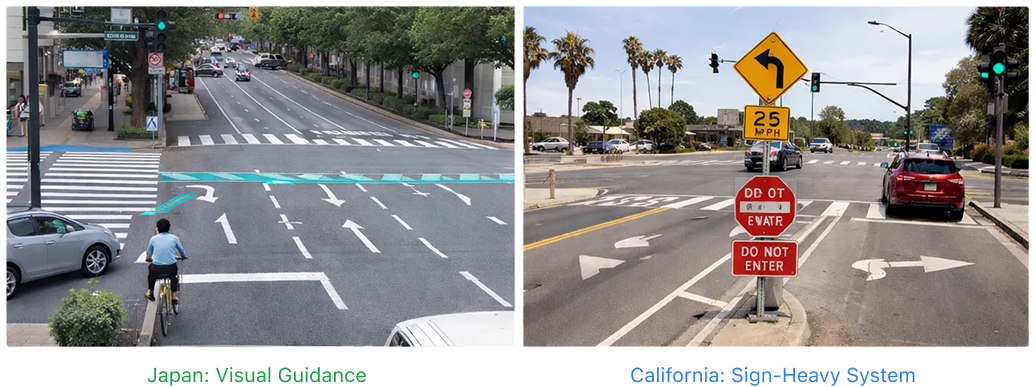
Japanese training often emphasizes predictability, visual guidance, and coordinated behavior. California driving places more responsibility on individual judgment and written rule interpretation.
Japanese traffic education often stresses:
- predictable flow
- group coordination
- visual cues
California traffic education stresses:
- individual responsibility
- written rule interpretation
- fast independent decisions
When education does not explain these mindset differences clearly, drivers are forced to learn through trial and error — which increases risk.
Language Directly Affects Confidence
Understanding instructions clearly changes how drivers behave behind the wheel. When drivers fully understand what is expected, they tend to act more calmly and decisively. When they are unsure, hesitation increases — and hesitation itself can create danger in traffic flow.
Drivers with clear comprehension typically:
- decide faster
- hesitate less
- feel calmer
Drivers with uncertainty often second-guess their actions. In real traffic, uncertainty can be just as risky as incorrect action.
Translation Alone Is Not Enough
Direct word-for-word translation does not automatically produce good traffic education. Effective learning requires explanation, examples, and real-world scenarios — not just language conversion.
Good traffic education includes:
- cultural explanation
- practical examples
- scenario context
Without context, translated rules can still feel abstract and confusing.
Native-Language Learning Improves Safety
Learning traffic rules in your native language reduces mental workload and improves comprehension. When drivers understand concepts directly — instead of translating — they respond more smoothly and confidently.
This is especially helpful for:
- new residents
- returning drivers
- drivers preparing for exams or traffic school
Understanding leads to safer behavior — not weaker standards.
After a Traffic Ticket, Clarity Matters Even More
After receiving a traffic ticket, many drivers experience fear, confusion, or embarrassment. In that emotional state, complex English instructions become even harder to process. Clear language support helps drivers understand what happened and how to prevent repeat mistakes.
Good education after a violation helps drivers:
- understand the mistake
- prevent repeat issues
- move forward calmly
Education supports safety better than punishment alone.
Related guide:
What Is Traffic School in California? (Explained for Japanese Drivers)
Language Access Supports Daily Life in California
Driving affects work, school, and family responsibilities. When drivers feel informed and confident, they integrate into daily California life more smoothly. Language-accessible education is not a shortcut — it is a safety tool.
Confident drivers tend to:
- drive more safely
- adapt faster
- experience less stress
Clear instruction supports both compliance and quality of life.
Summary
Traffic education works best when drivers truly understand the rules — not just the words used to describe them. Language clarity improves reaction time, confidence, and safe decision-making.
Key ideas to remember:
- language affects reaction and confidence
- context matters as much as translation
- cultural explanation improves understanding
- native-language support increases safety
Better understanding leads to safer driving and smoother adaptation in California.
This article is part of the Traffic School & Smart Solutions series.
Frequently Asked Questions
Is Japanese-language traffic education allowed?
Yes. If the program is DMV-licensed, language support is acceptable.
Does language support change the rules?
No. The rules remain the same — understanding improves.
Is this only for new drivers?
No. Even experienced drivers benefit from clearer explanations.
Enjoying this guide?
Get the next one in your inbox — no spam.
Get Notified When Courses Launch
Be the first to know when our DMV-licensed traffic courses become available. No spam, just one email.